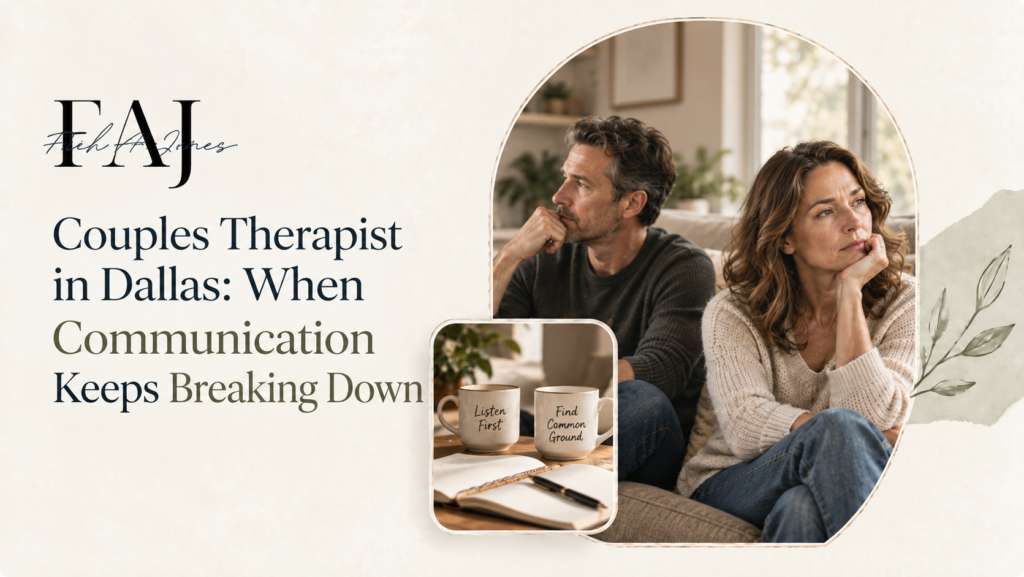
You start with something small. The dishes. A late text. Who said they’d call the plumber. Ten minutes later, you’re arguing about something that happened three years ago, and both of you walk away feeling unheard.
If that sounds familiar, you’re not alone, and your relationship isn’t broken. A couples therapist in Dallas can help you understand why your conversations keep derailing and teach you practical tools to talk, listen, and repair again. This guide explains the warning signs, the real causes, and what to expect when you finally ask for help.
Quick Answer: When Should a Couple See a Therapist for Communication Problems?
A couple should see a therapist when the same arguments repeat without resolution, when conversations turn into criticism or silence, or when either partner feels emotionally alone in the relationship. If you’re considering couples therapy in Dallas, you don’t need to wait for a crisis. Therapy works best early, before resentment hardens into distance.
That last point matters. Research from The Gottman Institute is often cited as showing that couples wait an average of about six years after problems start before seeking help. By then, the original issue is buried under years of hurt.
What Communication Breakdown Actually Looks Like
Communication problems in relationships are rarely about a lack of words. Most couples talk plenty. The problem is how they talk, and what happens in their bodies while they do.
How do you know if communication problems are hurting your relationship?
You’ll know communication problems are hurting your relationship when conversations leave you feeling more disconnected than before, when you avoid topics to keep the peace, or when small disagreements escalate into major fights. Watch for these signs:
- The same fight, on repeat. Different trigger, same script, same ending.
- Walking on eggshells. You rehearse what you’ll say or skip important topics entirely.
- Criticism instead of requests. “You never help” replaces “Could you handle dinner Tuesday?”
- Shutting down. One partner goes silent, leaves the room, or stares at their phone.
- Keeping score. Past mistakes get pulled into every new disagreement.
- Feeling like roommates. You coordinate logistics well but rarely share feelings.
- Nothing gets resolved. Arguments end from exhaustion, not agreement.
Why Communication Keeps Breaking Down: The Root Causes
In more than 35 years of counseling couples and training counselors, I’ve seen that relationship communication problems almost always trace back to a handful of deeper patterns. Fixing your phrasing helps a little. Understanding these patterns helps a lot.
| Root Cause | What It Looks Like | What’s Really Happening |
|---|---|---|
| Emotional flooding | Raised voices, racing heart, saying things you regret | Your nervous system shifts into fight-or-flight, and careful listening becomes nearly impossible. |
| Pursue-withdraw cycle | One partner pushes to talk; the other shuts down | Both are trying to protect the relationship in opposite ways, and each reaction fuels the other. |
| Unspoken needs | Arguing about chores, money, or schedules | The surface topic hides a deeper need: to feel valued, respected, or safe. |
| Family-of-origin patterns | Reacting “like my dad” or “like my mom” | You learned how to handle conflict long before you met your partner. |
| Unhealed hurts | Old betrayals resurfacing in new fights | An injury that was never repaired keeps demanding attention. |
| Life stress | More irritability during job changes, new babies, grief, or caregiving | Stress drains the emotional reserves couples need for patience. |
Dr. John Gottman’s widely cited research found that about 69% of relationship conflicts are “perpetual problems”, rooted in lasting differences in personality or values. They don’t get solved. They get managed. Healthy couples aren’t couples who never disagree; they’re couples who can discuss their differences without damaging the connection.
Can Couples Therapy Help With Communication Problems?
Yes. Couples therapy is one of the most effective ways to repair communication problems because it helps partners slow down conflict, understand the needs beneath their reactions, and practice new skills with a neutral professional guiding them.
The research is encouraging. According to the American Association for Marriage and Family Therapy (AAMFT), a large majority of clients surveyed reported improvement in their emotional health and rated their therapy as good or excellent. The American Psychological Association also recognizes couples-focused treatment as an evidence-based way to address relationship distress.
How does couples therapy improve communication?
Couples therapy improves communication by identifying your repeating conflict cycle, teaching de-escalation and active-listening skills, and helping each partner express needs without blame. Over time, you replace reactive habits with intentional ones.
Step-by-Step: How Couples Therapy for Communication Problems Works
Every couple is different, but effective couples therapy for communication problems usually follows a clear path.
- Assessment. Your therapist learns your history, strengths, and the specific patterns causing pain. This often includes time with each partner.
- Mapping the cycle. Together, you name the loop you get stuck in. Seeing it as “the cycle” instead of “your fault” lowers defensiveness fast.
- De-escalation skills. You learn to recognize flooding and take structured breaks (usually 20 minutes or more) before returning to the conversation.
- Speaking and listening tools. You practice “I feel… about… and I need…” statements, reflective listening, and validation, even when you disagree.
- Addressing deeper hurts. Once conversations feel safer, you can work through old wounds and unmet needs.
- Building repair habits. You learn how to recover after a bad argument, because every couple will still have them.
- Maintenance. Sessions become less frequent as you use the skills independently at home.
What should couples expect from their first therapy session?
In the first couples therapy session, expect to share what brought you in, describe your relationship history, and talk about your goals. The therapist will listen, ask questions, and begin to understand your patterns. No one is judged, and no one is “the problem.”
It’s normal to feel nervous. Many couples leave the first appointment feeling lighter simply because, for the first time in a long time, someone helped them both feel heard.
Real-World Examples: What Change Looks Like
The examples below are composites drawn from common patterns in couples counseling. Names and details are changed to protect confidentiality.
Marcus and Leah (married 12 years, North Dallas). Leah felt ignored; Marcus felt constantly criticized. Every conversation about their teenage son became a fight. In therapy, they identified a pursue-withdraw cycle. Leah learned to start conversations gently, and Marcus learned to stay engaged instead of retreating to the garage. Within a few months, they could plan parenting decisions together without raised voices.
Priya and Daniel (engaged, Uptown). They rarely argued, but they never talked about anything meaningful. Their “peace” was actually avoidance. Through couples counseling for communication issues, they learned to discuss money, family expectations, and faith before the wedding, building a stronger foundation for marriage.
Common Mistakes Couples Make When Communication Breaks Down
- Waiting too long. The longer patterns run, the more entrenched they become.
- Trying to “win” the argument. If one partner wins, the relationship loses.
- Having big talks at bad times. Late at night, when hungry, or in front of the kids rarely goes well.
- Using “always” and “never.” These words invite defensiveness, not understanding.
- Venting to everyone except your partner. Outside opinions can deepen the divide.
- Assuming therapy means the end. Couples therapy is a tool for strengthening relationships, not a last stop before divorce.
Expert Tips You Can Use Tonight
- Start soft. Begin with how you feel, not what your partner did wrong.
- Name the flood. Agree on a phrase like “I need a break, and I’ll come back in 30 minutes.” Then actually come back.
- Reflect before you respond. Say, “What I’m hearing is…” before sharing your side.
- Look for the need beneath the complaint. “You’re always on your phone” often means “I miss you.”
- Schedule a weekly check-in. Fifteen calm minutes on Sunday prevents many Thursday blowups.
- Repair quickly. A sincere “I’m sorry, that came out wrong” can turn a fight around.
Choosing the Right Couples Therapist in Dallas
When searching for an experienced marriage counselor in Dallas, a relationship therapist in Dallas, or a therapist for relationship problems in Dallas, look for:
- Specific training in couples and marriage counseling, not only individual therapy.
- State licensure through the Texas Behavioral Health Executive Council (for example, LPC, LPC-S, or LMFT).
- A balanced approach that doesn’t take sides.
- A good fit. Both partners should feel respected and safe, including couples who want faith-integrated, Christian marriage counseling.
- Convenient access across Dallas, including Uptown, Highland Park, University Park, Lakewood, Preston Hollow, and North Dallas, plus online counseling for eligible Texas clients.
Dr. French A. Jones, Ph.D., LPC-S brings more than 35 years of counseling experience. He holds a Ph.D. in Counselor Education and Marriage Counseling from the University of North Texas and served for 30 years as a Professor of Counseling Ministries at Dallas Theological Seminary, including eight years as department chair. His practical, direct, and respectful approach emphasizes honesty, understanding, accountability, and meaningful change. He sees clients at Southwest Clinical & Forensics, 8150 N. Central Expressway, Suite 1450, Dallas.
Frequently Asked Questions
Can a couples therapist help with constant arguments?
Yes. A couples therapist helps you identify what keeps triggering the same arguments, teaches you to calm conflict before it escalates, and guides you toward solutions or respectful compromise. Many couples notice fewer and shorter arguments within the first several sessions.
How long does couples therapy take to improve communication?
Many couples notice meaningful improvement within 8 to 12 sessions, though timing depends on how long patterns have existed and whether there are deeper injuries such as infidelity. Consistent practice between sessions speeds progress.
What if my partner doesn’t want to go to couples counseling?
Start by inviting rather than pressuring. Frame therapy as a way to feel closer, not to assign blame. If your partner still declines, individual counseling can help you change your side of the pattern, which often shifts the whole dynamic.
Is couples therapy only for couples on the verge of divorce?
No. Couples therapy helps engaged, newly married, and long-term couples strengthen communication, prevent problems, and reconnect. Seeking help early is a sign of commitment, not failure.
What’s the difference between couples therapy and marriage counseling in Dallas?
The terms are often used interchangeably. Marriage counseling in Dallas typically refers to married couples, while couples therapy and relationship counseling include dating, engaged, and married partners. The goals are similar: better communication, less conflict, and deeper connection.
Can we do couples counseling online?
Yes. Dr. Jones offers in-person sessions in Dallas and online sessions for eligible clients located in Texas, so busy couples can get support from home.
How do I schedule couples counseling in Dallas with Dr. Jones?
You can request a session online or call (214) 478-3121. The office is located at 8150 N. Central Expressway, Suite 1450, Dallas, TX 75206.
Take the First Step Toward Better Communication
Communication breakdowns don’t mean your love is gone. They mean your relationship needs new tools, and you don’t have to figure them out alone. Working with an experienced couples therapist in Dallas can help you stop the cycle, understand each other again, and build a relationship that feels safe and connected.
Ready to start? Schedule a session with Dr. French Jones today, or contact the office about couples counseling in Dallas at (214) 478-3121.