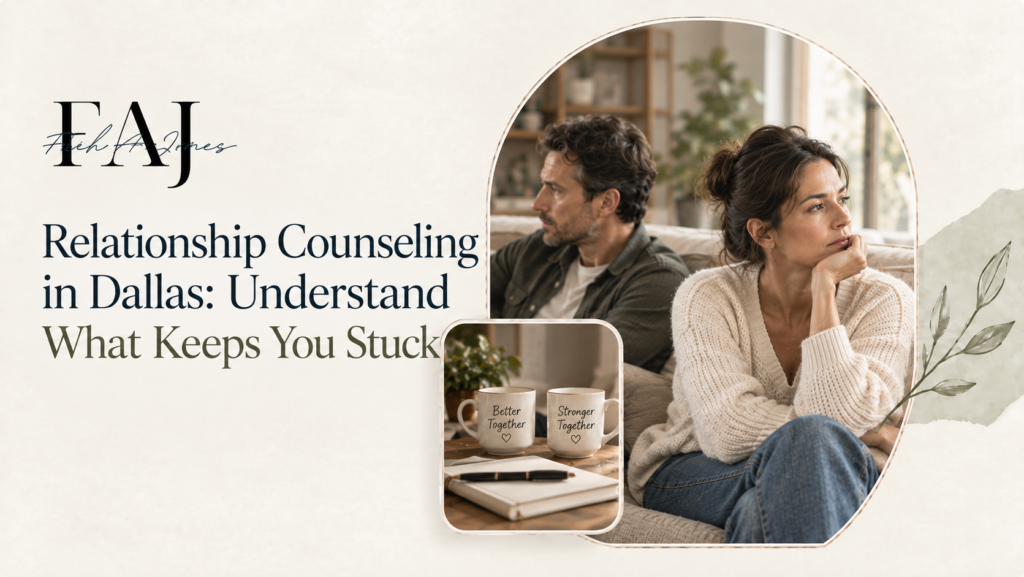
You love each other. You’ve both tried. You’ve read the articles, promised to “communicate better,” and maybe even had a few good weeks. Then something small happens, and you’re right back where you started.
Feeling stuck doesn’t mean your relationship is failing. It usually means you’re caught in a pattern neither of you can see clearly from the inside. Relationship counseling in Dallas helps couples name that pattern, understand what drives it, and replace it with something healthier. This guide shows you how.
Why Do Couples Keep Getting Stuck in the Same Relationship Patterns?
Couples get stuck because each partner’s reaction triggers the other’s, creating a self-reinforcing cycle. The argument isn’t really about the dishes or the money. It’s about deeper needs, such as feeling respected, safe, or important, that go unspoken while both people defend themselves.
Think of it like a dance. One partner steps forward (criticizes, pursues, pushes to talk). The other steps back (defends, withdraws, goes quiet). The more one pursues, the more the other retreats, and the more the other retreats, the harder the first one pursues. Neither person is the villain. The cycle is the problem.
This is why recurring relationship problems feel so exhausting. You’re not solving a new issue each time. You’re replaying the same script with different props.
What Are the Signs That a Relationship Is Stuck?
A relationship is stuck when the same conflicts return without resolution, when partners feel more like roommates than a couple, and when efforts to fix things lead to more distance rather than closeness. Common signs include:
- Déjà vu arguments. You can predict exactly how the fight will go.
- Avoiding certain topics to keep the peace, such as money, in-laws, sex, or the future.
- Emotional distance. You share a home and a calendar, but not your inner life.
- Scorekeeping. Old hurts get pulled into every new disagreement.
- One partner always pursues while the other always withdraws.
- Contempt or sarcasm has crept into everyday conversation.
- Hopelessness. One or both of you think, “This is just how we are.”
The Hidden Drivers: What Really Keeps You Stuck
In more than 35 years of counseling couples in Dallas and training counselors at Dallas Theological Seminary, I’ve found that most relationship problems trace back to a few predictable drivers. Understanding them is the first step to changing them.
| Driver | How It Shows Up | What’s Underneath |
|---|---|---|
| Negative interaction cycle | Pursue-withdraw or attack-defend loops | Both partners are protecting themselves from feeling rejected or inadequate. |
| Unspoken needs | Fights about chores, time, or money | A need to feel valued, respected, or prioritized. |
| Emotional disconnection | Living parallel lives, little affection | Unrepaired hurts and fear of being vulnerable. |
| Family-of-origin scripts | Reacting the way your parents did | Conflict habits learned in childhood. |
| Communication breakdown | Criticism, defensiveness, stonewalling | Emotional flooding that shuts down listening. |
| Life stress | More irritability during job changes, parenting, grief, or caregiving | Depleted emotional reserves. |
The four patterns that predict trouble
Dr. John Gottman’s research at The Gottman Institute identified four communication behaviors, often called the “Four Horsemen”, that strongly predict relationship breakdown: criticism, contempt, defensiveness, and stonewalling. Gottman’s research also found that about 69% of couple conflicts are perpetual, rooted in lasting differences. Healthy couples don’t eliminate these differences. They learn to talk about them without damaging each other.
If any of the Four Horsemen sound familiar, you’re dealing with unhealthy relationship patterns, and those patterns can be changed.
How Relationship Counseling Helps Couples Get Unstuck
Relationship counseling helps couples by making the hidden cycle visible, slowing down conflict so both partners can be heard, and teaching practical skills to express needs, repair hurts, and rebuild trust. A trained counselor acts as a neutral guide, not a referee.
According to the American Association for Marriage and Family Therapy (AAMFT), most clients who work with marriage and family therapists report improvement in their emotional health and satisfaction with their care.
Step-by-step: what the process looks like
- Understand your story. Your counselor learns your history, strengths, and what brought you in.
- Map the cycle. Together you name the loop, for example, “When you go quiet, I push harder, and then you shut down.”
- Slow things down. You learn to spot emotional flooding and take structured breaks before damage is done.
- Name the real needs. Beneath “You never help” is often “I feel alone.” Saying the real need changes the conversation.
- Practice new skills. Soft start-ups, reflective listening, validation, and repair attempts are practiced in session.
- Heal old wounds. Once it feels safer, you can address betrayals or hurts that keep resurfacing.
- Build lasting habits. You leave with tools you can use long after counseling ends.
Can therapy help couples break unhealthy communication patterns?
Yes. Therapy helps couples break unhealthy communication patterns by identifying triggers, interrupting the cycle as it happens, and practicing healthier responses with professional feedback. Most relationship communication problems improve once both partners feel safe enough to stop defending and start listening.
Relationship Counseling vs. Couples Therapy vs. Marriage Counseling
Relationship counseling, couples therapy, and marriage counseling are closely related and often used interchangeably. Relationship counseling is the broadest term and can include dating, engaged, or married partners. Marriage counseling focuses on married couples. Couples therapy can also address deeper emotional or mental health factors affecting the relationship.
| Service | Who It’s For | Common Focus |
|---|---|---|
| Relationship therapy in Dallas | Dating, engaged, or married partners | Patterns, communication, trust, direction |
| Couples counseling in Dallas | Any committed couple | Conflict, reconnection, practical skills |
| Marriage counseling in Dallas | Married couples | Marital roles, commitment, family, faith |
The labels matter less than the fit. What matters most is working with an experienced professional who understands relationships and helps both partners feel respected.
Real-World Examples: Getting Unstuck
These examples are composites based on common counseling patterns. Names and details are changed to protect confidentiality.
James and Tanya (together 7 years, Lakewood). Every weekend ended in an argument about time: Tanya wanted more together, James wanted rest. In counseling, they discovered Tanya’s real fear was being last on James’s list, and James felt he could never do enough. Once they named those needs, they built a simple weekend plan that honored both. The fights stopped feeling like threats.
Robert and Elena (married 22 years, Preston Hollow). No yelling, no drama, just silence. After their kids left home, they realized they barely knew each other. This kind of emotional disconnection in relationships is common after major life transitions. Counseling helped Robert learn to share feelings he’d kept to himself for years, and helped Elena stop reading his quiet as rejection.
Common Mistakes That Keep Couples Stuck
- Focusing on who’s right. Winning the argument usually means losing connection.
- Waiting for a crisis. Research from The Gottman Institute is often cited as showing couples wait around six years after problems begin before seeking help.
- Treating symptoms, not the cycle. Solving one fight doesn’t change the pattern that creates the next one.
- Going it alone. Friends and family often take sides, which deepens the divide.
- Believing counseling means failure. Strong couples seek support early.
Expert Tips You Can Start This Week
- Name the cycle, not the person. Say “We’re in our loop again” instead of “You always do this.”
- Use a soft start-up. “I feel ___ about ___, and I need ___.”
- Take a real break when flooded. Twenty to thirty minutes, then come back.
- Share one appreciation a day. Small positives build a buffer for hard conversations.
- Try a weekly 15-minute check-in. Ask, “What’s one thing I could do to help you feel loved this week?”
When Should You Consider Relationship Counseling in Dallas?
You should consider relationship counseling when the same problems keep returning, when conversations cause more distance than closeness, or when trust has been damaged. You don’t need to wait for a crisis. Earlier support is often easier and more effective.
How do you know when a relationship needs professional support?
A relationship needs professional support when you’ve tried to fix things on your own and nothing changes, when relationship conflict is escalating, or when one or both partners feel hopeless, lonely, or unsafe. If there is physical violence or fear for your safety, contact the National Domestic Violence Hotline at 1-800-799-7233 first.
Why Dallas Couples Choose Dr. French Jones
Dr. French A. Jones, Ph.D., LPC-S is a relationship therapist in Dallas with more than 35 years of counseling experience. He earned his Ph.D. in Counselor Education and Marriage Counseling from the University of North Texas and taught counseling at Dallas Theological Seminary for 30 years, including eight years as department chair.
- Practical, direct, and respectful approach focused on honesty, accountability, and meaningful change
- In-person sessions at 8150 N. Central Expressway, Suite 1450, convenient to Uptown, Highland Park, University Park, Lakewood, and North Dallas
- Online relationship counseling for eligible Texas clients
- Christian marriage counseling available for couples who want faith integrated into their work
If you’ve been searching for a couples therapist in Dallas or couples therapy in Dallas that feels both expert and personal, you’re in the right place.
Frequently Asked Questions
Why do couples keep getting stuck in the same relationship patterns?
Couples get stuck because each partner’s protective reaction triggers the other’s, creating a repeating cycle. The surface topic changes, but underlying needs such as respect, safety, and closeness stay unmet until the cycle is named and interrupted.
How can relationship counseling help couples?
Relationship counseling helps couples identify destructive patterns, improve communication, resolve recurring conflict, repair trust, and rebuild emotional closeness with the guidance of a neutral, trained professional.
When should you consider relationship counseling?
Consider relationship counseling when problems keep repeating, when you feel emotionally distant, after a breach of trust, or during major life transitions such as marriage, a new baby, or an empty nest.
Can therapy help couples break unhealthy communication patterns?
Yes. Therapy helps couples recognize triggers, slow down conflict, and practice healthier ways to speak and listen, such as soft start-ups, validation, and repair attempts.
What is the difference between relationship counseling and couples therapy?
The terms overlap. Relationship counseling is broader and includes any committed partners, while couples therapy may also address deeper emotional or mental health factors. Both aim to improve communication and connection.
Is online relationship counseling available in Texas?
Yes. Dr. Jones offers online sessions for eligible clients located in Texas, along with in-person sessions at his Dallas office.
How do I get started with relationship counseling in Dallas?
Request a session online or call (214) 478-3121. Dr. Jones’s office is at 8150 N. Central Expressway, Suite 1450, Dallas, TX 75206.
Take the First Step Toward Getting Unstuck
Being stuck isn’t the end of your story. It’s a signal that your relationship needs a new way forward. With the right relationship counseling in Dallas, you can understand what keeps you stuck, stop repeating the same painful patterns, and rediscover the connection you both want.
Ready to start? Schedule a session with Dr. French Jones, or contact the office about relationship counseling in Dallas at (214) 478-3121. Support for your relationship problems is closer than you think.