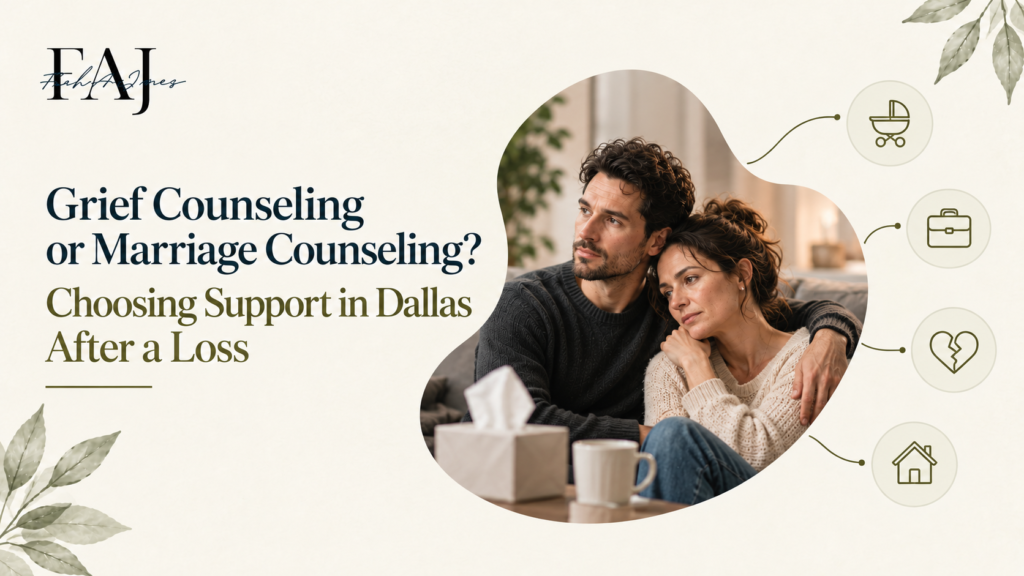
After a death in the family, many couples notice two kinds of pain at once. There is the loss itself: the person who is gone, the empty chair, the phone call that won’t come. And then there is what the loss is doing to the marriage. One spouse wants to talk about it every night. The other goes quiet and throws himself into work. Small disagreements turn sharp. Both people are hurting, and somehow they are hurting alone.
If you’re weighing grief counseling vs marriage counseling, here is the short answer. Grief counseling focuses on one person’s experience of loss: the sadness, guilt, anger, and adjustment that follow a death. Marriage counseling focuses on how the loss is affecting the relationship between two people. If the main struggle is your own grief, individual support often comes first. If the loss has left you disconnected or in constant conflict, couples counseling may help. Many people benefit from both.
This guide explains the difference, how to choose, and what support looks like for couples looking at marriage counseling in Dallas after a loss.
What Is the Difference Between Grief Counseling and Marriage Counseling?
Grief counseling helps a person make sense of a loss and carry it. The focus is on the bereaved person: their memories, their unanswered questions, their changed daily life, and the feelings that come in waves.
Marriage counseling, sometimes called couples counseling, treats the relationship as the focus. Both partners attend. The counselor helps the couple understand how they are reacting to each other, why they feel distant, and what each of them needs during a hard season.
| Grief counseling | Marriage counseling | |
|---|---|---|
| Main focus | One person’s experience of loss | The relationship between two people |
| Who attends | Usually the grieving person | Both partners |
| Often a good fit when | Grief is affecting sleep, work, or daily life | The loss has led to distance, conflict, or misunderstanding |
| Common questions | “How do I live with this?” | “Why can’t we get through this together?” |
The two aren’t rivals. They answer different questions, and the right starting point depends on which question feels most urgent.
How Grief Can Affect a Marriage
A loss doesn’t stay in one corner of life. Grief often brings exhaustion, irritability, poor sleep, and less patience for ordinary problems. Those changes show up at home.
Spouses also tend to grieve on different schedules and in different ways. One partner may cry openly and want to look at photos. The other may stay busy, avoid the subject, or seem “fine” too quickly. Each style can look like a lack of caring to the other person. The article on why spouses mourn so differently looks at this in more depth.
The American Psychological Association notes that “everyone reacts differently to death” and that some people struggle with grief for long periods, to the point that daily life becomes hard (APA, Grief: Coping with the loss of your loved one). When two people react differently in the same house, misunderstanding is common.
Grief can also deepen problems that were already present. If a couple was already dealing with emotional distance in marriage before the loss, the loss may widen it.
When Grief Counseling May Be the Better First Step
Individual support for grief may fit best when:
- Your grief is affecting sleep, appetite, work, or basic routines for a long time.
- You feel stuck on guilt, “what ifs,” or the circumstances of the death.
- You need space to grieve without worrying about how your spouse will react.
- Your spouse is not ready to attend counseling with you.
Some people choose a counselor who focuses specifically on grief. Others prefer a counselor who also understands marriage and family life, because the loss is tangled up with their relationships. Both are reasonable choices. If your spouse won’t come, the article on whether individual counseling can help your marriage explains what working alone can and can’t change.
When Marriage Counseling May Be the Better First Step
Couples counseling may fit best when:
- You and your spouse keep misreading each other’s grief.
- Arguments have increased since the loss, often about things that seem unrelated.
- One partner feels abandoned while the other feels pressured.
- The loss has forced decisions you disagree on, such as caring for a surviving parent, finances, or where to live.
- You feel more like roommates than partners.
In these situations the problem lives partly between you, so having both people in the room usually helps.
Can You Do Both?
Yes. Many couples combine the two, either at the same time or one after the other. For example, a wife grieving her mother might meet individually for a few sessions, then begin couples sessions when the strain on the marriage becomes clearer. Some counselors provide both. Others prefer to refer to individual grief work elsewhere. Ask about this before you begin.
If you’re unsure how to choose the format, the guide to individual counseling, couples counseling, or both walks through the decision.
Grief Isn’t the Only Life Change That Strains a Marriage
Death is one kind of loss. Couples also grieve in quieter ways: after a job loss, a move away from family, a hard pregnancy, or the house going quiet when the kids leave. These changes can unsettle a marriage in similar ways. The article on when couples counseling can help you adjust to big life changes covers those transitions.
What Grieving Couples Can Do Right Now
Whatever support you choose, a few steps can ease the strain at home:
- Name the difference out loud. “I think we’re grieving differently” can lower tension more than any argument about who is right.
- Ask, don’t assume. “What helps you on hard days?” is better than guessing.
- Share the load. Make a short list of practical tasks, like paperwork, meals, and calls, and divide them.
- Protect small moments of connection. A short walk or a cup of coffee together can matter more than a long talk.
- Watch for warning signs. Persistent hopelessness, heavy drinking, or withdrawal from everyone are signs to seek help sooner.
If grief has brought thoughts of harming yourself, call or text 988 to reach the 988 Suicide & Crisis Lifeline. If anyone is in immediate danger, call 911.
Not Sure Where to Start?
If the season feels so heavy that even picking a counselor feels like too much, start small. The guide on preparing for counseling during a hard season breaks the first steps into manageable pieces.
Finding Support in Dallas After a Loss
Dr. French A. Jones, Ph.D., LPC-S, is a Licensed Professional Counselor Supervisor in private practice in Dallas, Texas. He works with individuals and couples, and his practice lists grief, stress, and major life transitions among the concerns he helps people work through. Matters of faith are welcome in sessions when they matter to you and are never imposed. You can learn more about Dr. French Jones, or read about online marriage counseling in Texas if coming to an office feels hard right now. Online sessions are for clients located in Texas.
Frequently Asked Questions
What is the difference between grief counseling and marriage counseling?
Grief counseling focuses on one person’s experience of a loss and how to live with it. Marriage counseling focuses on how a loss, or any other strain, is affecting the relationship between two partners. Some people need one, and many benefit from both.
Can couples go to grief counseling together?
Yes. Some couples attend sessions together to grieve a shared loss, such as the death of a child or parent. Joint sessions can help partners understand each other’s grief. Individual sessions may still help when one partner needs space to grieve privately.
Can grief cause marriage problems?
Grief doesn’t break marriages on its own, but it can strain them. Exhaustion, different grieving styles, and stressful decisions after a death often lead to distance or conflict. Addressing the strain early usually makes it easier to work through.
When should I see a counselor for grief?
Consider counseling if grief is making daily life hard for a long period, if you feel stuck on guilt or the circumstances of the death, or if the loss is causing ongoing conflict at home. You don’t need to wait until things feel unbearable.
How long after a loss should we try marriage counseling?
There is no rule. Some couples seek help within weeks because conflict rises quickly. Others notice the strain months later, when the first wave of support fades. If the loss is pulling you apart, it is reasonable to start whenever you notice it.
Is online counseling available for grieving couples in Texas?
Yes. Dr. Jones offers online sessions for individuals and couples located in Texas. Online sessions can help when grief makes leaving home, arranging childcare, or driving across Dallas feel like too much.
Taking the Next Step
Grief is hard enough without feeling alone inside your own marriage. Whether you need space for your own grief, help understanding each other, or both, support can make the season more bearable. When you’re ready, you can schedule a counseling appointment with Dr. French Jones in Dallas or online in Texas, or explore marriage counseling in Dallas first.
This article is for general education and is not a substitute for professional advice about your specific situation.